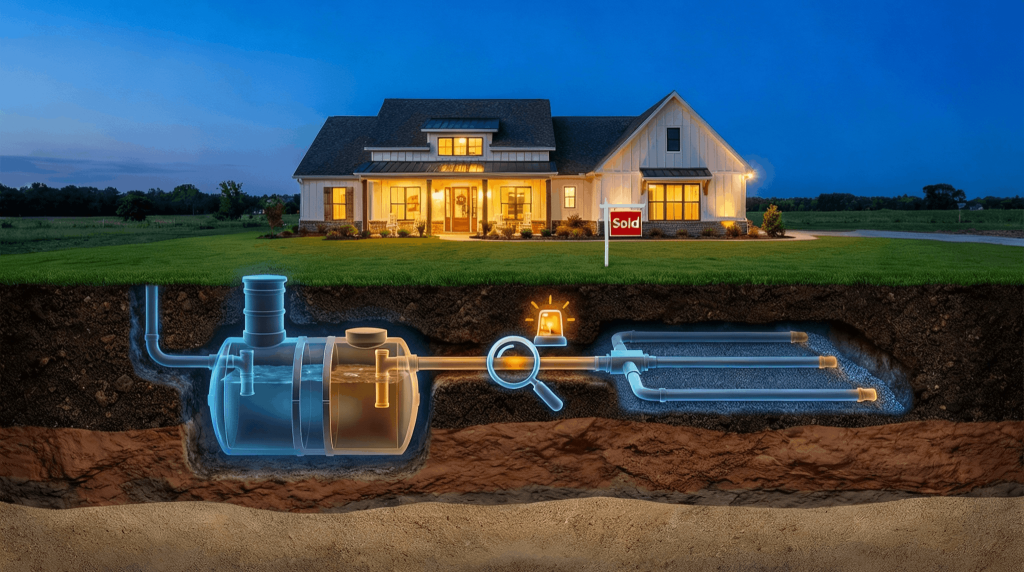
For many, the Indiana “American Dream” means moving to the quiet charm of Morgan County, the woods of Hendricks County, or the rural pockets of Hamilton County. But when you buy a rural home, you aren’t just buying property; you are becoming the operator of a private wastewater treatment plant buried in your backyard.
In Indiana, approximately 800,000 homes rely on septic systems. Many of these systems are reaching the end of their functional lifespan, and failing systems can result in public health hazards. Without a specialized inspection, you could be inheriting an expensive repair or a full replacement cost reaching $20,000 or more.
Why a Standard Home Inspection Isn’t Enough
What is the difference between a home inspection and a specialized septic inspection?
A general home inspector focuses on the structure and visible plumbing. They are generalists. At Owens Septic & Excavation, we are specialists who use specialized equipment, cameras, and hydraulic stress tests to verify the condition of the system hidden underground.
- The “Flush Test” Failure: General inspectors often just run a faucet. If it drains, they pass it. This fails to account for a saturated drain field that can handle three flushes but not three loads of laundry.
- The Scope Gap: Home inspectors rarely dig up tank lids or pump the system.
- Liability: If the system backs up two weeks after closing, the buyer usually has no recourse against a general inspector.
The Two-Stage Science: How Your System Works
How does a septic system treat waste?
It is a biological ecosystem that uses physics (gravity) and biology (bacteria) to clean water.
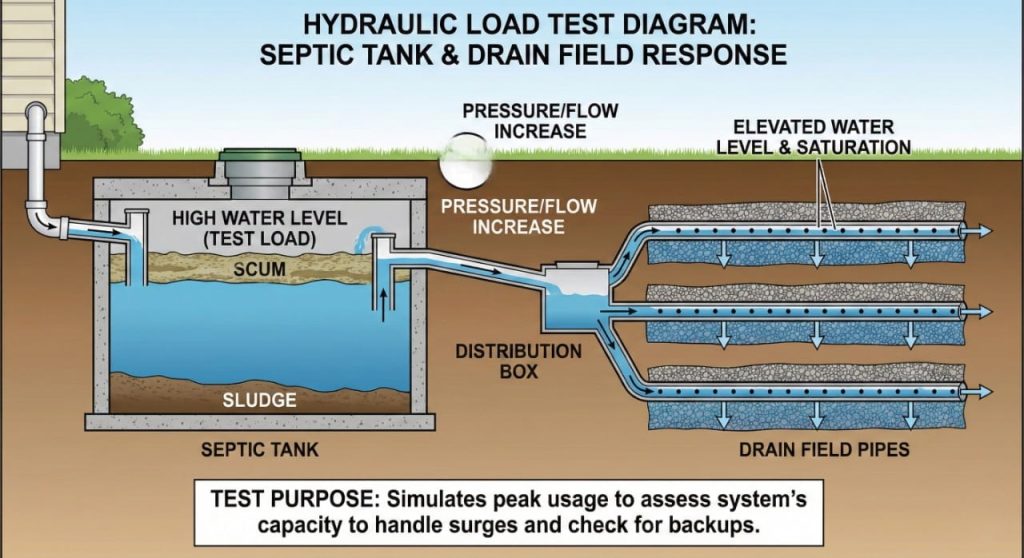
- Stage One (The Tank): Solids settle at the bottom (sludge), and oils float to the top (scum). Bacteria digest the middle layer of liquid (effluent).
- Stage Two (The Drain Field): Effluent flows into the soil where a “biomat” of bacteria filters out pathogens before the water reaches Indiana’s groundwater.
Comparison: Standard Home Inspection vs. Owens Septic Specialist
Feature | General Home Inspector | Owens Septic Specialist |
Flush Test | Yes | Yes (Advanced Stress Test) |
Digging Up Lids | No | Yes |
Internal Tank Exam | No | Yes (After Pumping) |
Camera Inspection | Rare | Yes |
Hydraulic Load Test | No | Yes |
Soil Analysis | No | Yes |
The Anatomy of a Pre-Purchase Inspection
What happens during a professional septic inspection?
At Owens Septic & Excavation, we perform a multi-step “stress test” to ensure the system can handle your family’s daily needs.
- Step 1: Paperwork Deep Dive: We verify permits. A “bootleg” system without a permit is an automatic red flag.
- Step 2: Visual Site Analysis: We look for the “Golf Course” effect—unnaturally lush, green grass over the drain field which indicates sewage is rising to the surface.
- Step 3: The Internal Exam: We pump the tank to inspect the concrete walls for cracks and ensure the baffles (which keep sludge out of your yard) are intact.
- Step 4: The Hydraulic Load Test: We introduce a controlled volume of water into the system to simulate peak usage. This allows us to monitor if the absorption field can effectively handle the daily effluent load of your household without backing up.
Indiana’s Unique Challenges: Clay and Mounds
Why does geography matter for Indiana septic systems?
In Central Indiana, heavy clay soil acts like a “bathtub,” holding water rather than letting it filter through. This often requires a Mound System.
- The “Bathtub” Effect: Clay has low permeability. If the soil is saturated, the system overflows.
- Mound Systems: These are elevated drain fields built with imported sand. They are highly effective but expensive.
Estimated Investment for Septic Services in Central Indiana 2026
Service | Estimated Cost |
Standard Real Estate Septic Inspection | $450 – $900 |
Routine Tank Pumping (up to 1,000 gallons) | $350 – $550 |
New Drain Field (Standard) | $6,000 – $15,000 |
New Mound System | $18,000 – $30,000+ |
Don’t Negotiate in the Dark
Need an expert estimate to take to the closing table?
If we find a problem, we provide a real-world quote for repairs.
Red Flags Homebuyers Should Watch For
How can I spot a failing septic system during a home showing?
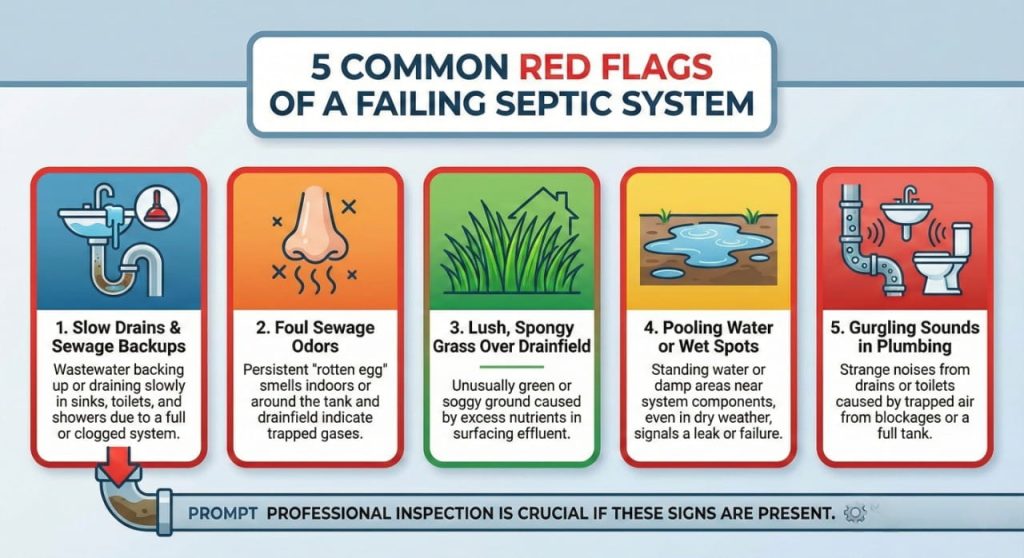
While you need a pro for the final word, keep your senses sharp for these warning signs:
- Auditory: Listen for gurgling in the drains after a flush.
- Olfactory: A “rotten egg” smell (sewer gas) near the backyard or in the basement.
- Visual: Soggy patches or black slime (sewage bacteria) on the ground.
- Documentation: If a home has been vacant for 6 months, the system may seem fine until you move in and saturate the dry soil.
Confused by local Indiana county health regulations?
Our team understands the specific health department requirements for Morgan, Hendricks, and Johnson counties, as well as the surrounding Central Indiana areas.
The “Grandfathered” Myth
Does an old system have to meet current Indiana codes?
Under Indiana State Department of Health Rule 410 IAC 6-8.3, any system that discharges effluent to the surface or into groundwater is considered a failure. In these cases, the system must be brought up to current Indiana residential onsite sewage system standards, regardless of when it was originally installed.
FAQs for Indiana Septic Owners
Who typically pays for the septic inspection: Buyer or Seller?
In Indiana, the inspection is usually the buyer’s expense, similar to a standard home inspection. This ensures the inspector is working for your interests. However, it is common to ask the seller to pay for the required tank pumping (~$300-$500) so the inspection can be performed.
How long does a thorough septic inspection take?
A real, specialized inspection takes 2 to 3 hours. This includes locating and digging up lids, pumping the tank, and performing hydraulic stress tests. If an inspector is done in 20 minutes, they haven’t performed a complete check.
Can a septic system fail even if it was recently pumped?
Yes. Pumping only empties the tank; it does not fix a failed drain field. Sellers may pump a failing system right before a showing to hide the fact that the water level is backing up. Only a Hydraulic Load Test can prove the field is actually absorbing water.
What happens if the inspection finds a major problem?
Finding a problem gives you leverage. You can walk away, ask the seller to fix it before closing, or negotiate a price reduction. Note that FHA, VA, and USDA loans typically require a failing system to be replaced before they will fund the loan.
What is a "dye test" and when is it used?
A dye test involves flushing a fluorescent tracer down the toilet. If the dye appears in your yard or a nearby ditch, it is irrefutable proof that raw sewage is escaping the system. We recommend this for older homes or systems located near streams.
Are you ready to sign the papers with total confidence?
Don’t let a buried problem become your financial nightmare.
