The $400 Maintenance Visit vs. The $15,000 Disaster
For the 800,000 Indiana households using septic systems, the tank is the “check engine light” of the home. It runs silently until neglect turns a routine service into a financial crisis. As we move into 2026, rising disposal fees and Indiana’s notorious heavy clay soil make proactive septic tank pumping more critical than ever.
How Much Does Septic Pumping Cost in Indiana?
The cost to pump a 1,000-gallon septic tank in Central Indiana typically ranges between $350 and $650, depending on your specific location and tank accessibility. While national averages exist, Indiana homeowners face specific local price drivers:
- 1,000 Gallons: The Indiana standard for 3-bedroom homes.
- Central Indiana Rates: Competitive pricing, though costs may vary based on whether septic filter service is included.
Rural Surcharges: Depending on your distance from service hubs, travel requirements can influence the final quote.
2026 Regional Price Benchmarks
Region/City | Service Density | Estimated 1,000-Gallon Cost |
Indianapolis (Metro) | High | $350 – $450 |
Bloomington (Monroe Co.) | Moderate | $393 – $515 |
Martinsville (Morgan Co.) | Moderate/Rural | $320 – $419 |
Zionsville / Carmel | High | $375 – $500 |
Rural Central Indiana | Low | $350 – $550 |
The “Bloomington Effect”: Why Fees are Rising
Reflecting ongoing infrastructure updates, the City of Bloomington Utilities (CBU) septage dumping rates have reached approximately 8 cents per gallon—a significant increase from historical rates of 2 cents.
This shift means a standard 1,000-gallon load now costs haulers significantly more to process. Homeowners in Monroe and surrounding counties should expect this to be reflected in current service invoices. This trend of rising disposal costs is expected to continue as more Indiana municipalities modernize aging treatment infrastructure.
Why Indiana Clay Makes Pumping Non-Negotiable
Central and South Central Indiana are dominated by heavy clay soils. Unlike sandy soils that drain easily, clay has low permeability. When you neglect pumping, solids escape the tank and enter the drain field, creating a “biomat”—a waterproof barrier of organic sludge.
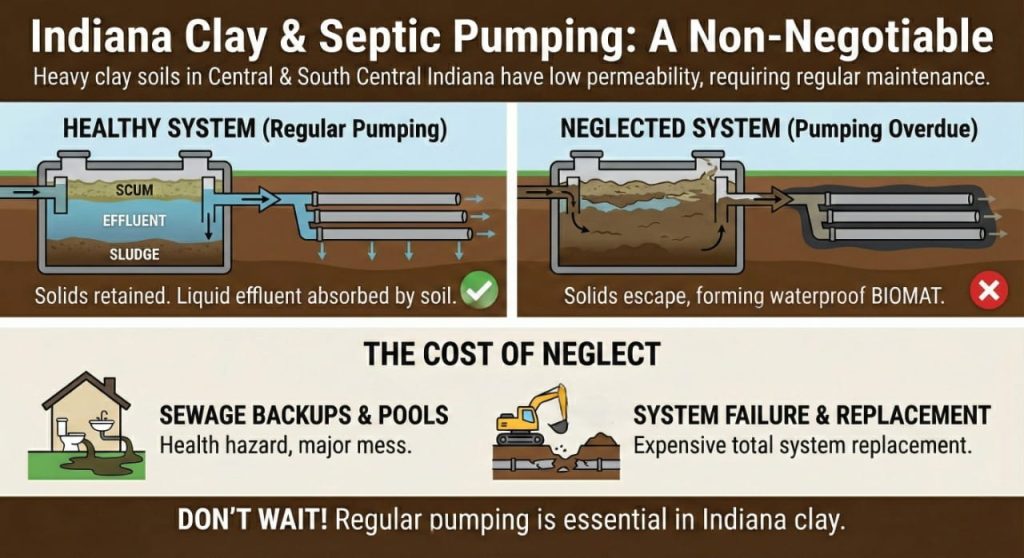
- Soil Blinding: Once clay pores are filled with solids, the soil stops absorbing water.
- The Result: Sewage pools in your yard or backs up into your home.
- The Cost: Repairing a “blinded” clay drain field often requires a total system replacement.
Pumping Frequency: The 1,000-Gallon Standard
Indiana design standards typically calculate waste based on the number of bedrooms in the home. For a 3-bedroom home, a 1,000-gallon tank is designed to provide sufficient “retention time” for solids to settle. If the tank is full of sludge, that retention time disappears, and waste is pushed directly into your soil.
Recommended Pumping Intervals:
- 1–2 People: Every 3 to 5 years.
- 3–4 People: Every 2 to 3 years.
- 5+ People: Every 1 to 2 years.
- Garbage Disposal Users: Should pump more frequently, as these units significantly increase solid waste buildup.
Maintenance vs. “Miracle” Additives
Many products claim to “eliminate the need for pumping.” However, industry research from Purdue University and the EPA confirms these are often ineffective or even harmful to your system.
Comparison: Pumping vs. Chemical Additives
Feature | Professional Pumping | “Miracle” Additives |
Removes Solids | Yes (Physical removal) | No (Breaks them into smaller pieces) |
Protects Drain Field | Yes | No (Can cause “clogging” carryover) |
Scientifically Proven | Yes | No (Debunked by EPA/Purdue) |
Long-term Cost | Low ($400 range every 3 years) | High (Risk of $15k+ failure) |
The Financial ROI of Prevention
In 2026, a new “alternative” septic system (such as a Mound or ATU) can cost between $10,000 and $25,000 due to rising material and labor costs.
Economic Insight: Adhering to a $400–$500 pumping schedule every three years provides a 3,000% ROI compared to the cost of an emergency system replacement.
Total 20-Year Maintenance Budget
- Routine Pumping: $2,400 – $4,000
- Filter Cleaning/Inspections: $1,500 – $3,000
- Total: ~$4,000 – $7,000
- VS. System Replacement: $15,000 – $25,000+
Signs Your System is Failing (The “SOS”)
- Gurgling Pipes: Air trapped in the plumbing by an overfull tank.
- Lush Green Grass: A sign effluent is “wicking” to the surface because it can’t drain downward through the clay.
- Slow Drains: Particularly noticeable during the wet Indiana spring.
- Odors: The distinct “rotten egg” smell of failing anaerobic digestion.
Notice any of these red flags?
Owens Septic offers “No-Surprise” pricing and over 30 years of experience managing the unique challenges of Indiana’s heavy clay soils.
FAQs for Indiana Septic Owners
How often should I pump a 1,000-gallon tank in Indiana?
Most households of three to four people should pump every two to three years. Because Indiana clay is less forgiving than other soil types, preventing solid carryover is the most important step in extending your system’s life.
Does the price include the disposal fee?
This varies by provider. With the 2026 fee increases in areas like Bloomington, many companies now list this as a separate line item or an adjusted surcharge. Always ask if “disposal” or “dumping” fees are included in your quote.
Do I need to be home when the technician arrives?
While not strictly required if your lids are exposed or you have had a septic riser installation, it is highly recommended. Being present allows the technician to show you the sludge levels and the condition of your outlet baffles and filters.
Can I use additives instead of pumping?
No. Additives do not remove the non-biodegradable solids that build up over time. In fact, some additives can liquefy grease—much like why commercial kitchens require regular grease trap pumping—and send it directly into your drain field.
What are Rule 410 IAC 6-8.3 updates?
Indiana state health department rules (410 IAC 6-8.3) govern the design and maintenance of residential sewage systems. Local health departments are increasingly enforcing operating permit requirements that may necessitate proof of professional pumping every three to five years to stay in compliance with local ordinances.
